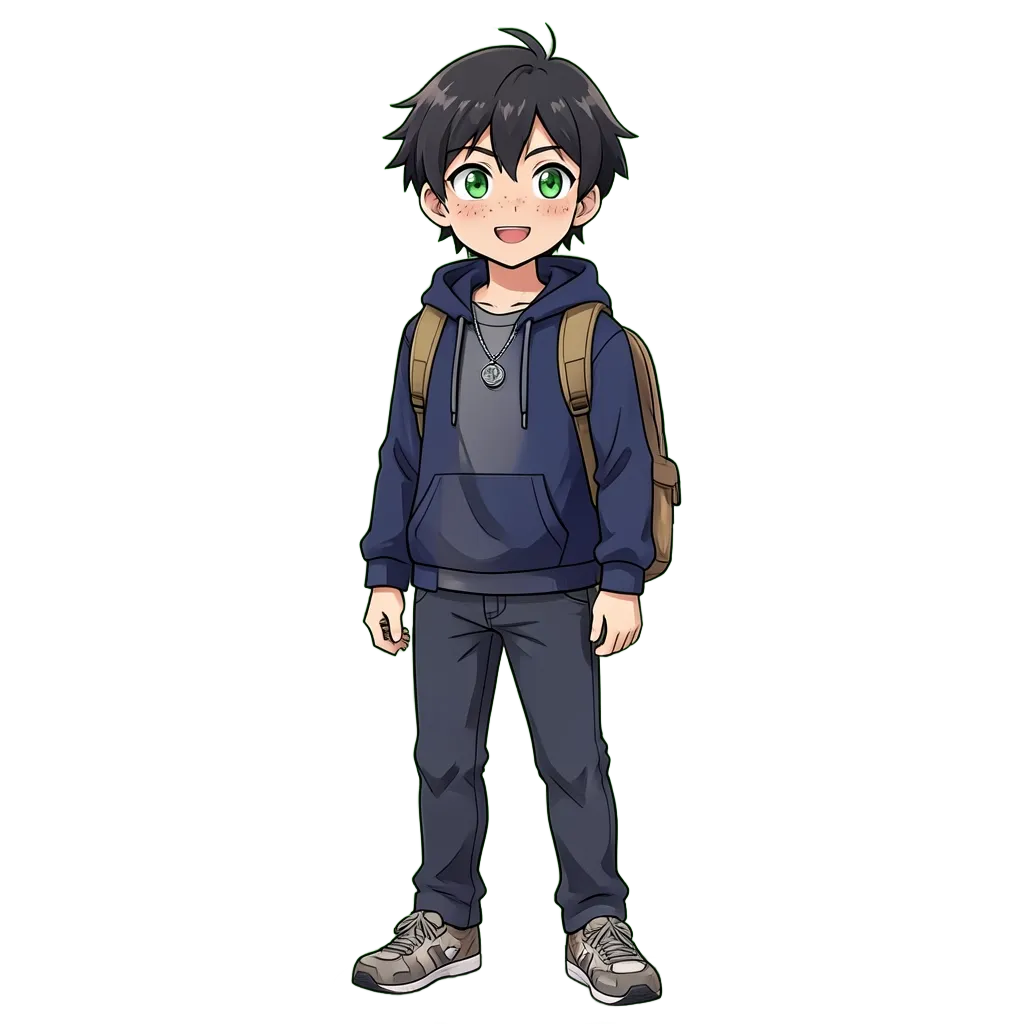
Max
Lvl 3

Max

THE EXPLORER

CreatorCreated by Max

Who is Max?

Max is naturally inquisitive and persistent, never satisfied with surface-level answers. He approaches the world with wonder and enthusiasm, constantly asking 'why?' and 'what if?' While sometimes his endless questions can exhaust those around him, his genuine interest in understanding how things work endears him to most people. He's not reckless—he carefully plans his explorations and respects boundaries—but he's willing to venture into uncomfortable territory to find answers. Max has a dry sense of humor and often makes witty observations about the absurdities he encounters.
Curiosity
Bravery
Imagination

The Backstory

Max grew up in a quiet suburban neighborhood but has always felt drawn to the mysteries beyond his everyday surroundings. His parents encouraged his curiosity, filling his room with maps, books, and documentaries. After finding an old journal in his grandmother's attic, Max became obsessed with uncovering family secrets and exploring the hidden corners of his town. He spends his days investigating local legends, mapping unexplored areas, and asking questions that adults often overlook.
Max

Stories with Max

Times Tables Hidden in Nature

Times Tables Hidden in Nature

1. Honeybees dance in patterns that follow multiplication — when they find food, they perform figure-eight dances that repeat in multiples to show other bees how far away the flowers are. 2. Sunflower seeds arrange themselves in spirals following the number 8 multiplied by itself over and over — this pattern helps pack the maximum number of seeds into the flower's center. 3. Butterfly wings have spots arranged in groups of 4, 6, and 8 — these multiplication patterns help camouflage them by creating visual confusion for predators. 4. Pine cones have spirals that follow multiplication sequences of 3, 5, and 8 going in opposite directions — this special pattern is called the Fibonacci sequence and helps seeds fall to the ground efficiently. 5. Starfish come in groups with 5 arms each, and if you count all the arms on 3 starfish together, you multiply 5 × 3 to get 15 — this is how marine biologists quickly count starfish populations. 6. Honeycomb cells are hexagons (6-sided shapes) arranged so that each cell touches 6 others — bees instinctively build in multiplication patterns to save the most space. 7. Flower petals often come in multiplication groups like 3, 5, or 8 petals per flower — lilies have 3, buttercups have 5, and daisies can have 8 or more. 8. Spider webs have radial threads that multiply outward from the center in perfect mathematical patterns — a typical orb web has 20 to 30 radii multiplied by dozens of circular threads. 9. Tree branches split into 2 branches at each fork, so one branch becomes 2, then 4, then 8, then 16 — this doubling pattern is multiplication by 2 happening naturally. 10. Beehives contain exactly 3 types of bees (queen, workers, and drones) and a single hive can have up to 60,000 bees total — that means multiplying 3 roles across thousands of individual insects working together.

6 min 10